The Offshore Ledger: Why the FTSE 100 Is a Global Index Wearing a British Address
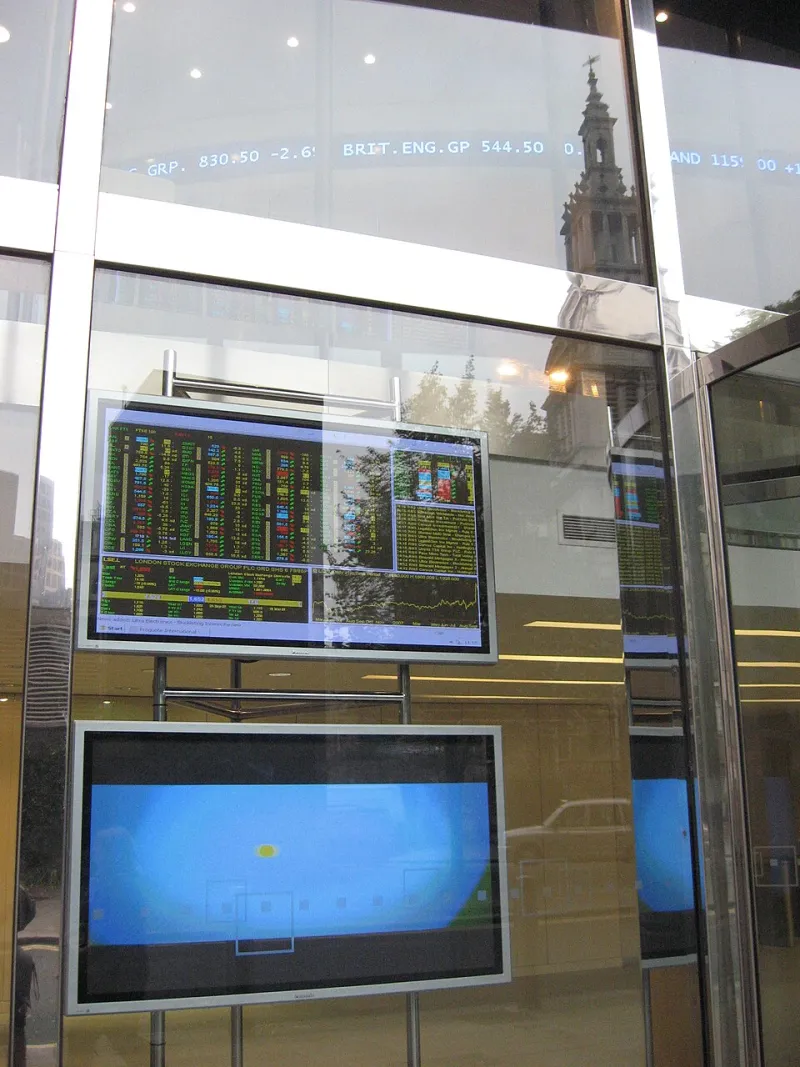
Photo: Kaihsu Tai, CC BY-SA 3.0, via Wikimedia Commons
A Benchmark With a British Domicile, Not a British Economy
The FTSE 100 occupies a peculiar place in UK investment culture. It is quoted on every news bulletin, used as a proxy for national economic mood and treated by many savers as the stock-market expression of Britain itself. That shorthand has always been imperfect. In 2026, it is increasingly misleading.
The index is composed of the largest companies listed in London, but listing location is not the same as economic geography. Many of its constituents earn the bulk of their revenue outside the UK. Mining groups sell into global commodity cycles, pharmaceutical companies price in dollars and euros, energy majors are exposed to international crude benchmarks, and consumer staples groups derive large portions of profit from emerging and developed markets. The result is an index whose fortunes are tied more closely to world growth, commodity prices and sterling translation than to the day-to-day condition of the UK domestic economy.
This is not a flaw in the index. It is a feature of the London listing venue. But it matters enormously for how investors interpret the signal.
What the Sector Mix Actually Reveals
The FTSE 100’s sector composition explains much of its behaviour. It is weighted toward mature, cash-generative industries: energy, mining, banking, insurance, pharmaceuticals and consumer staples. Those sectors can be attractive for income-seeking investors, particularly when dividend cover is sound and balance sheets are conservative. They are also structurally different from the more domestically geared areas of the UK market, such as mid-caps, small-caps and consumer-facing businesses that depend on British household demand, sterling spending and UK policy conditions.
That distinction is critical. A weak month for UK retail sales or a deterioration in domestic business confidence may barely register in the FTSE 100 if global commodity prices are firm and sterling is stable. Conversely, a slowdown in Chinese industrial demand or a sharp move in the dollar can dominate the index even when UK economic data are improving. The blue-chip benchmark is therefore less a bellwether for Britain than a barometer for the global cash flows that happen to be intermediated through London.
For equity income investors, this cuts both ways. The index offers access to large, internationally diversified businesses with long dividend histories. But it also concentrates exposure in sectors that are cyclical, capital-intensive or exposed to regulatory and political risk beyond the UK. Income is not the same as safety, and global diversification is not the same as domestic representation.
Sterling, Translation and the Illusion of Domestic Exposure
Currency adds another layer of complexity. Many FTSE 100 companies report in sterling but earn in other currencies. When sterling weakens, the translated value of overseas earnings rises; when sterling strengthens, the reverse occurs. This mechanical effect can make the index appear to rally when UK economic sentiment is poor, or fall when domestic conditions are improving. Investors who use the FTSE 100 as a real-time referendum on Britain are therefore reading a distorted signal.
The distortion is not merely technical. It shapes behaviour. A rising index can foster a sense of domestic confidence that is not supported by household incomes, business investment or public finances. A falling index can suggest national decline when the underlying movement is a global repricing of mining stocks or a shift in US rate expectations. In both cases, the index is doing its job as a global equity benchmark while failing as a domestic economic indicator.
Why the Listing Venue Still Matters
If the FTSE 100 is not a domestic bellwether, why should London investors care about it at all? The answer lies in the infrastructure that surrounds the listing. London remains a significant venue for capital formation, secondary liquidity, index inclusion, corporate governance and takeover activity. The rules that govern listed companies — disclosure standards, shareholder rights, board accountability and market abuse controls — are part of the value proposition for investors. So is the depth of the professional ecosystem: analysts, custodians, brokers, lawyers and asset managers who underwrite the market’s day-to-day functioning.
Those features matter even when the revenue does not originate in the UK. A company may be globally diversified, but its listing determines the legal and regulatory framework under which investors engage with it. It affects how easily shares can be traded, how transparently management must report, and how robustly minority shareholders are protected. For UK pension funds, insurers and retail investors, that framework is not incidental. It is part of the risk assessment.
London’s challenge is not that its blue-chip index is international. It is that the venue must continue to attract companies that want those standards, that liquidity and that investor base. If the FTSE 100 becomes merely a legacy address for businesses that no longer see London as their natural home, the index may remain large while the market’s relevance erodes. That is a capital-markets question, not a macroeconomic one.
Reading the Index Properly
For UK investors, the practical conclusion is not to ignore the FTSE 100 but to use it with discipline. It can be a useful allocation tool for global earnings exposure, dividend income and large-cap liquidity. It should not be treated as a proxy for UK GDP, household consumption or domestic small-business conditions. Those signals are better found in the FTSE 250, in sterling credit spreads, in UK gilt yields and in the admittedly less glamorous data on wages, vacancies and investment intentions.
The FTSE 100’s foreign accent is not a recent affectation. It is central to what the index is. Recognising that does not diminish London’s listing venue. It simply asks investors to read the label before relying on the measurement.